
Talking TPLO with Pet Parents

Recommending surgery to pet owners brings challenges that are completely different from diagnosing the source of pain or lameness. One of the most common conversations DVMs need to have is how to recommend a TPLO. Dr. Kim Tong shares how he discusses the procedure with pet parents and his tips for these conversations.
Covering the Basics
When the Cranial Cruciate ligament (CrCL) is torn, the knee becomes unstable, and the tibia (shin bone) will shift forward abnormally when standing, walking, or otherwise bearing weight. This tibial thrust, or abnormal shifting of the knee, can lead to pain, inflammation, cartilage damage, osteoarthritis, and sometimes meniscal tears. A cruciate ligament will not regenerate and does not heal on its own; therefore, a surgical procedure such as the TPLO may be warranted.
The TPLO (Tibial Plateau Leveling Osteotomy) is a surgical procedure that stabilizes the knee by altering the biomechanics of the joint. With this change to the geometry of the knee, the ligament is no longer needed.
When to Recommend TPLO
The TPLO has historically been shown to be the most reliable and effective method for stabilization of a stifle with cranial cruciate ligament (CrCL) disease. This means that if there is any CrCL disease, a partial or full tear, a TPLO may be warranted. While there may be numerous methods for CrCL tears, close to 80% of all ACVS surgeons prefer the TPLO.1
Of the various options available, the TPLO has also been shown to be effective in getting patients back to near normal function and has a low complication rate.
What is a Partial Tear and What to Do
When you have a stifle that has palpable cranial drawer and/or tibial thrust, it is pretty clear that a full CrCL tear is likely. These are CrCL-deficit stifles that would highly benefit from a TPLO. However, how do you diagnose a partial tear? Partial tears often are much harder to diagnose on a physical exam. You likely won't get tibial thrust, and even getting a cranial drawer may be absent. If you notice the findings mentioned below, a partial tear may be possible..
- Chronic intermittent lameness of a pelvic limb that is worse with activity
- Pain with full extension of the stifle
- Mild cranial drawer when the stifle is tested in flexion
- Or you might not get any cranial drawer
- Joint effusion that is either palpable or noted on X-rays.
- Thickening (or fibrous bulge) of the medial aspect of the stifle called “medial buttress”
Even though the stifle may feel stable with a partial tear, we often expect these to progress and lead to chronic lameness and eventually a full tear. Partial tears are good candidates for TPLOs and should be considered!

How to Present the Idea of TPLO to Owners
It can be a shock for owners to learn that their pet needs major surgery for their knee. It may even be harder to swallow if their pet is minimally limping. Although we, as veterinarians, see a TPLO as a routine surgery, a pet owner may find the concept of a TPLO quite invasive. And they're not wrong to see it this way! We are cutting through muscle, looking into the joint, cutting and rotating a portion of a bone, and putting an implant into the bone. That can be scary!
Ways to Ease Owners into the Idea of TPLO:
- Emphasize that a trained surgeon has likely done a large number of TPLOs in their career. Having this experience dramatically reduces the risks and increases success rates.
- Percentages vary depending on study, but it is reasonable to quote an owner a “less than 10% complication rate and greater than 90% success rate.”
- Many pets that get a TPLO often are using the leg quite well even just a couple weeks after surgery. We often expect them to be fully functional just a couple months post-surgery.
- Share a recent TPLO success story with the owner.
Explaining How TPLO Works
When a pet tears their CrCL, the knee becomes unstable in a forward/backward motion. This instability causes pain, inflammation, cartilage damage, and may lead to meniscus tears. The TPLO flattens the top of the tibia (joint surface) and this flattening prevents this abnormal motion. The TPLO biomechanically stabilizes an unstable knee.
Explain that the veterinary surgeon will cut the tibia bone (this is the “osteotomy”) with a semi-circular saw. They then rotate that segment to “level” out the joint surface (“tibial plateau”) to a specific pre-determined measurement. Hence, Tibial Plateau Leveling Osteotomy.
After the cut and rotation are made, a specialized TPLO implant is screwed into the bone to hold the osteotomy together while the bone heals over time. When the tibial plateau is leveled out like this, it counteracts the tibial thrust that was initially the cause of instability. Stable knee, happy pet!

Why Owners Should Consider TPLO Over Other Surgical Options or Conservative Management
TPLO is considered the “gold standard” for treating the CrCL-deficient stifle. A survey conducted with the Veterinary Orthopedic Society found that almost 80% of its members endorsed the TPLO as their first option (when asked about dogs >15kg). While debatable, research on outcomes often gives TPLO the edge over other techniques including the TTA, extra-capsular suture, and tape fixators.
Unless there are contraindications to surgery (high anesthesia risk, other major illness, finances), surgery is recommended over conservative management in dogs. Without surgical stabilization of the knee, there will be continued pain, inflammation, cartilage wear, and worsening arthritis.
Common Fears Pet Owners Have
The most common fear is COST. Other fears include invasiveness of surgery, risks of complications, and difficulty of recovery (see above).
Frequently Asked Owner Questions and How to Answer Them
"Can small dogs or cats have TPLOs?"
TPLO implants go all the way down to 1.5mm sizes! So yes, both small dogs and cats can have a TPLO. Dr. Kim Tong’s personal opinion is that small dogs often seem to do even better than big dogs after TPLO!
"What is the cost?"
Depending on where people live in the US, cost for a TPLO can range between a few thousand USD to over 10,000 USD. Price ranges can also vary based on if it is performed at a specialty referral hospital, a general practice with a mobile surgeon, or a general hospital by a non-boarded veterinarian.
"What are the risks?"
Less than 10% complications rate and greater than 90% success rate.
"What does after-care look like?"
In a non-complicated recovery, we expect a pet to recover from a TPLO within 2-4 months. Even though the pet may start using its leg well within the first month after surgery, it usually takes around 2 months for the bone to heal. Then, it may take 1-2 months after that to get back to optimal functionality.
Patients are recommended to be strictly confined for the majority of the recovery time so they do not hurt themselves even if they look like they’re back to their pre-injury selves. Walks and activity should be allowed gradually, slowly increasing over the recovery period. Every surgeon will have slightly different guidelines and recommendations post-operatively so details may vary a bit. The key is that you communicate the need for post-op care and the protocol you recommend early in the process to gain commitment from pet parents.
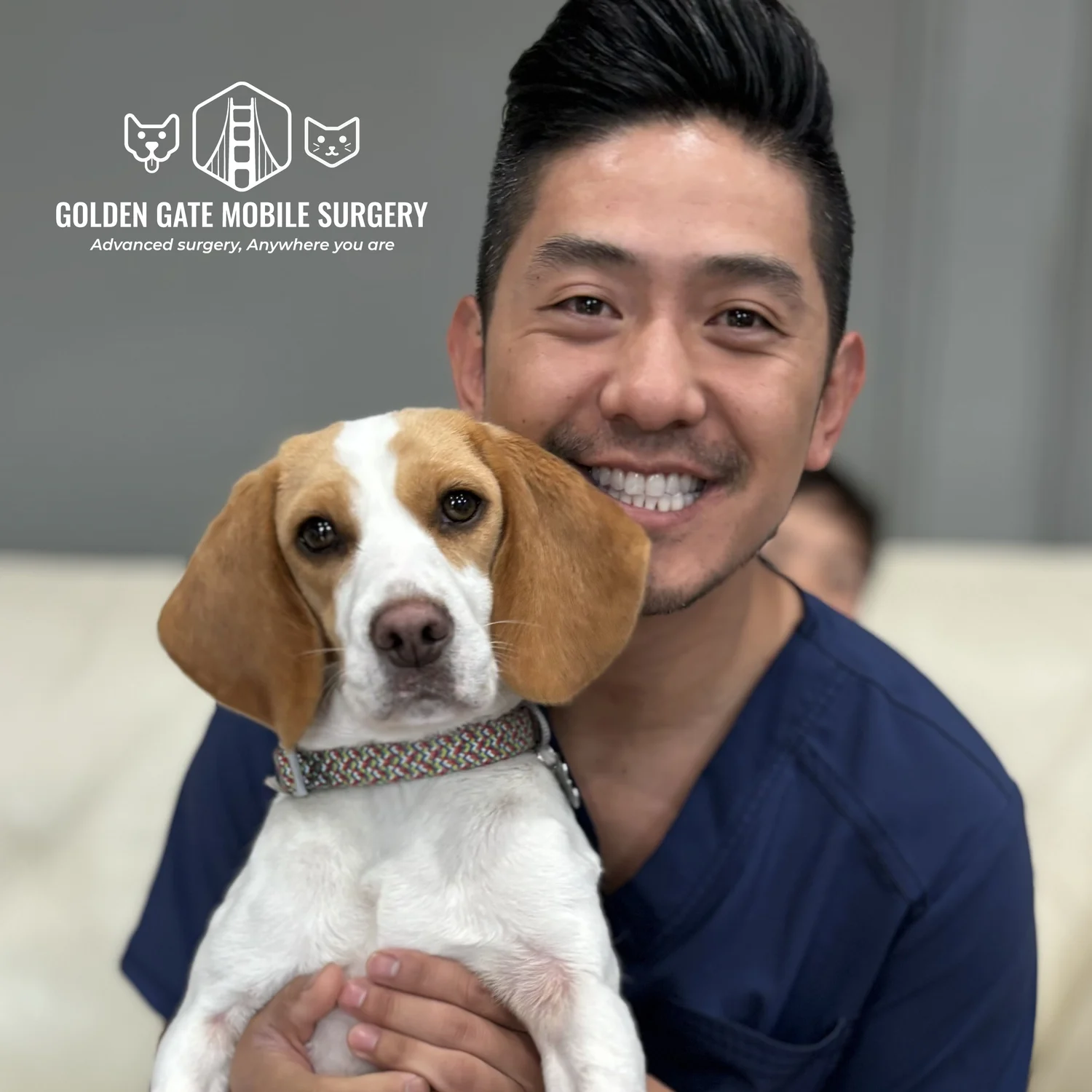
Kim Tong, DVM, DACVS-SA
Article written by: Dr Tong
Follow: @drkimpawsible
Golden Gate Mobile Surgery - California, USA
References:
- Dirsko J F von Pfeil, Michael P Kowaleski, Mathieu Glassman, Loïc M Dejardin Results of a survey of Veterinary Orthopedic Society members on the preferred method for treating cranial cruciate ligament rupture in dogs weighing more than 15 kilograms (33 pounds). J Am Vet Med Assoc. 2018 Sep 1;253(5):586-597. doi: 10.2460/javma.253.5.586 https://pubmed.ncbi.nlm.nih.gov/30110219/
